
📞 Call (517) 301-3122 — Free Estimate
Energy Efficient Windows in Lansing — What Homeowners Need to Know
Energy efficient windows in Lansing are a practical necessity rather than an optional upgrade. Mid-Michigan’s heating season runs six to seven months, outdoor temperatures regularly drop below zero in January and February, and the temperature differential across your window glass during a cold snap can exceed 70 degrees. Every window in your home is either managing that differential effectively or letting heat out through the glass. Modern energy-efficient units manage it. Single-pane windows, early double-pane units without low-E coatings, and aluminum frames do not — and the cost of that underperformance shows up on your gas bill every month from October through April.
This guide covers what makes a window genuinely energy efficient, how to read the performance numbers on a window label, what to look for when comparing options, and what Lansing’s specific climate demands from any replacement unit you install.
What Makes a Window Energy Efficient
Energy efficiency in a window comes from four compounding factors working together. A window that excels in one area but falls short in another will underperform relative to its rated specification in real-world conditions.
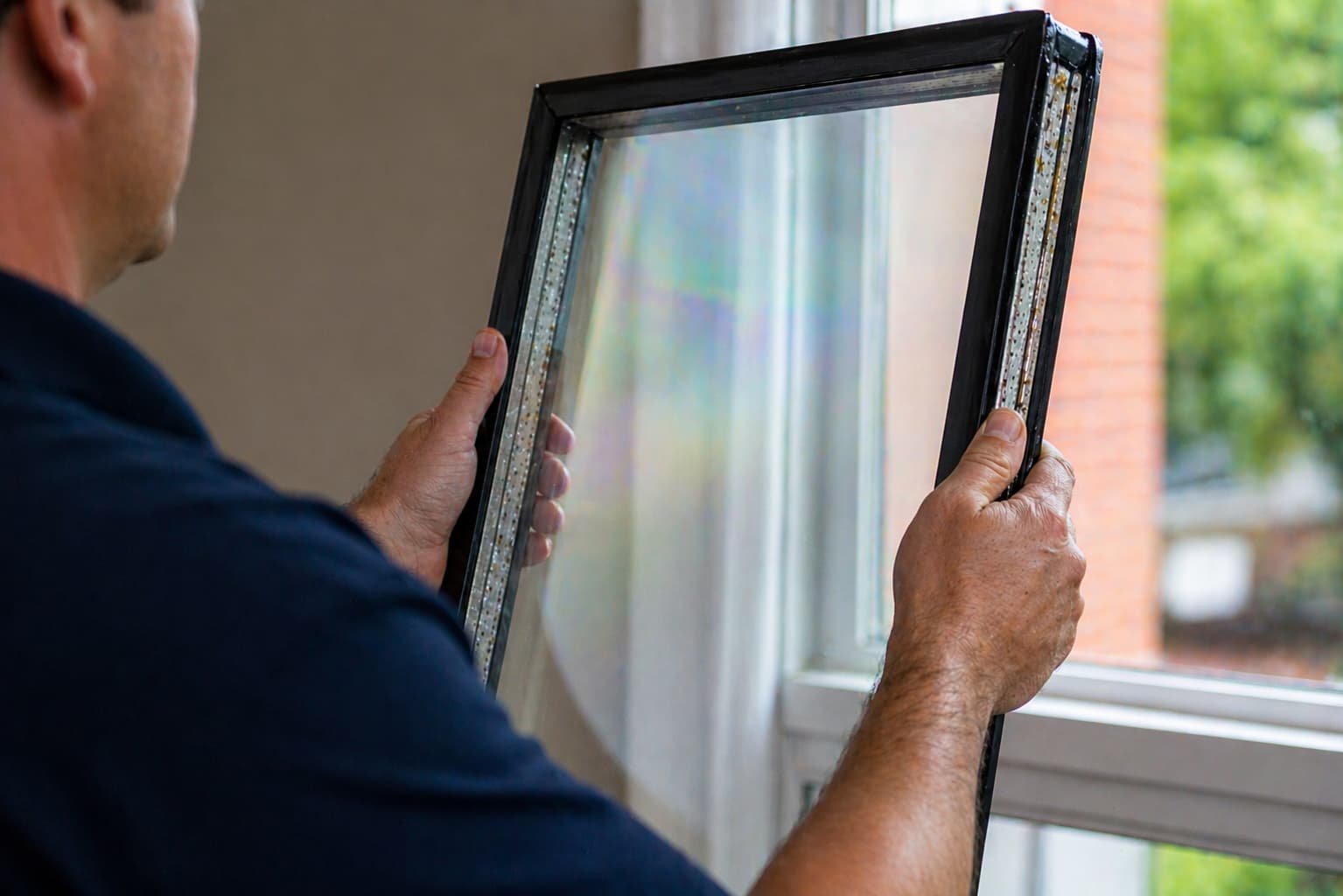
- Low-E glass coating — Low-emissivity coatings are microscopically thin metallic layers applied to one or more glass surfaces inside the unit. They reflect infrared heat back into the room in winter, reducing the rate at which warmth radiates through the glass to the cold exterior. In summer, they reduce solar heat gain on south and west-facing elevations. Low-E coatings are the single most impactful technology in a modern replacement window and should be present on any unit installed in Lansing’s climate.
- Argon or krypton gas fill — The cavity between the panes in a double or triple-pane unit is filled with an inert gas rather than air. Argon is the standard choice — it is denser than air, conducts heat less readily, and is cost-effective to use in standard double-pane units. Krypton is denser still and used in triple-pane units where the cavity between panes is narrower. Both gases degrade the thermal conductance of the unit compared to an air-filled cavity.
- Warm-edge spacer bars — The spacer bar that separates the two panes around the perimeter of the unit conducts heat at the glass edge, creating a thermal bridge that reduces the overall performance of the window. Aluminum spacers — standard in older units — conduct heat readily. Warm-edge spacers made from foam, composite, or stainless steel conduct heat far less readily and improve overall unit performance, particularly at the glass edge where condensation first appears in cold weather.
- Frame material — The frame conducts heat independently of the glass unit. Aluminum frames — common in Lansing’s 1960s and 1970s housing stock — are highly conductive and significantly reduce the thermal performance of even a good glass unit. Vinyl frames conduct heat at a fraction of the rate of aluminum. Fiberglass frames perform similarly to vinyl with added structural rigidity. Wood frames vary depending on species and condition but are far better than aluminum in thermal terms.
Reading the Window Label — U-Factor and SHGC
Every window sold in the United States carries a National Fenestration Rating Council (NFRC) label with two primary performance numbers: U-factor and Solar Heat Gain Coefficient (SHGC).
U-factor measures the rate of heat transfer through the window — how quickly heat moves from the warm interior to the cold exterior. Lower U-factor means better insulation. Energy Star’s Northern climate zone, which covers all of Michigan, requires a U-factor of 0.22 or below. Standard double-pane low-E argon units from reputable manufacturers typically achieve U-factors in the 0.25 to 0.30 range. Higher-performance units with triple panes and enhanced coatings reach 0.20 and below. When comparing quotes in Lansing, U-factor is the number that matters most — it directly measures how well the window will perform through a Michigan winter.
SHGC measures how much solar heat the window admits. A higher SHGC means more solar heat gain — which is beneficial on south-facing elevations in winter but can cause overheating on west-facing elevations in summer. For Lansing’s heating-dominated climate, a moderate SHGC in the range of 0.25 to 0.40 is generally appropriate. Very low SHGC values optimised for cooling climates are not the right choice for mid-Michigan.
Energy Star Northern Zone — What It Means for Lansing
Energy Star divides the United States into four climate zones for window ratings. Michigan falls entirely within the Northern zone — the most demanding thermal specification. A window that carries the Energy Star Northern zone certification has been independently tested and verified to meet the U-factor and SHGC thresholds set for cold-climate performance. When evaluating replacement windows in Lansing, Energy Star Northern zone certification is the minimum quality threshold worth considering. Units rated only for the North-Central or Southern zones will underperform in mid-Michigan’s winters regardless of what the marketing materials claim.
What Lansing’s Older Housing Stock Needs
The most common starting point for Lansing-area window replacement is a home with original wood-frame single-pane windows or early aluminum-frame double-pane units installed during 1970s energy retrofits. Neither performs remotely close to current Energy Star standards. A single-pane window has a U-factor in the range of 1.0 to 1.2 — four to five times worse than a modern Energy Star Northern zone unit. An early double-pane aluminum-frame unit without low-E coating typically has a U-factor of 0.45 to 0.60 — still roughly twice as poor as a modern replacement. The thermal improvement from upgrading either of these to a modern low-E argon vinyl unit is not incremental. It is substantial and immediate.
For independent energy efficiency ratings and the full Northern zone specification requirements, visit energystar.gov.