
📞 Call (517) 301-3122 — Free Estimate
Energy Efficient Windows in Lansing, MI
Energy efficient windows in Lansing are not a luxury upgrade — they are a practical response to a climate that demands it. Michigan’s heating season runs from October through April, sometimes longer, with sustained periods where outdoor temperatures drop well below freezing and the temperature differential across your window glass runs 50 to 70 degrees. Every unit in your home is either holding that heat in or letting it out. Modern energy-efficient glass systems hold it in. Original single-pane windows, early double-pane units without low-E coatings, and aluminum frames do not.
At Window Replacement Lansing, we install double-pane low-E windows with argon gas fill as our standard energy-efficient option — the same specification that meets Energy Star requirements for the Northern climate zone that covers all of Michigan. For homeowners who want the highest available thermal performance, we also supply triple-pane units and fiberglass frames, which offer better dimensional stability and lower conductivity than vinyl in extreme cold.
The case for energy efficient windows is strongest in Lansing’s older housing stock. The Westside and Southside hold thousands of homes built before 1970, many of which still have their original wood-frame single-pane windows or early aluminum-frame double-pane units installed during 1970s energy retrofits. Neither performs adequately by modern standards. A home with original single-pane windows is losing a disproportionate share of its heating costs through the glass every winter — and the loss is consistent, month after month, for the entire length of Michigan’s heating season. Replacing those units with modern low-E argon glass eliminates that loss at the source.
What Makes a Window Energy Efficient
- Low-E glass coating — A microscopically thin metallic layer applied to the glass surface that reflects infrared heat back into the room in winter and blocks solar heat gain in summer. Standard on all energy-efficient units we install.
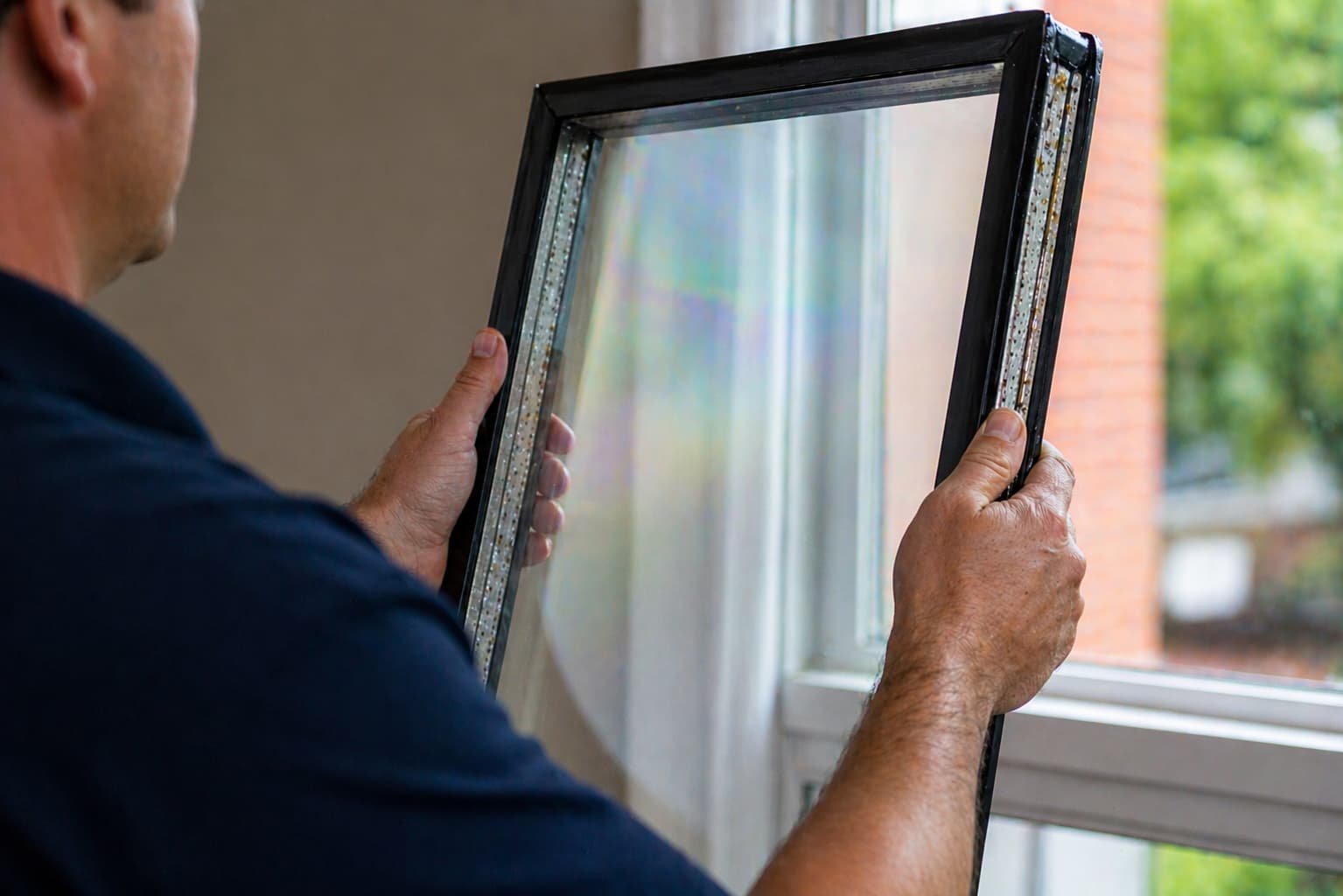
- Argon gas fill — The space between the panes in a double-pane unit is filled with argon, a dense inert gas that conducts heat less readily than air. This is the primary mechanism that gives modern double-pane windows their thermal advantage over older units.
- Warm-edge spacer bars — The spacer between the glass panes conducts heat at the edge of the unit. Warm-edge spacers made from foam or composite materials reduce this edge conduction compared to aluminum spacers found in older units.
- Vinyl or fiberglass frames — Both materials are far less thermally conductive than the aluminum frames found in much of Lansing’s 1960s–1980s housing stock. Vinyl is the standard choice; fiberglass offers additional rigidity for larger openings.
U-Factor and Solar Heat Gain — What the Numbers Mean
The two key performance numbers on any energy-efficient window are U-factor and Solar Heat Gain Coefficient (SHGC). U-factor measures how well the window insulates — lower is better, and Energy Star’s Northern zone requires a U-factor of 0.22 or below. SHGC measures how much solar heat the glass admits — for Michigan’s heating-dominated climate, a moderate SHGC is beneficial in winter but should not be so high that it causes overheating on south-facing elevations in summer. We explain these numbers in plain terms during the free estimate and match the right specification to your home’s orientation and heating load.
Double-Pane vs Triple-Pane in Lansing’s Climate
Double-pane low-E argon units are the right choice for most Lansing homes — they meet Energy Star Northern zone requirements, perform well through Michigan winters, and represent a significant thermal improvement over anything installed before 1990. Triple-pane units add a third pane and a second gas-filled cavity, reducing the U-factor further and improving performance in extreme cold. The additional cost is justified for homes with large north-facing window areas, older construction with significant air leakage, or homeowners who heat with electricity and face higher per-BTU costs. We advise on whether the upgrade is worth it for your specific situation during the estimate.
The Payback in Lansing’s Climate
Homes with original single-pane windows or early double-pane units without low-E coatings typically see a meaningful reduction in heating costs in the first full winter after replacement. The exact savings depend on how many windows are replaced, the current condition of the old units, your home’s heating system, and your usage patterns. We do not quote specific dollar savings figures because they vary by home — but in Lansing’s climate, the thermal improvement from modern low-E argon units over original windows is not marginal. It is substantial and consistent across every month of the heating season.
We serve homeowners throughout Lansing, East Lansing, Okemos, Holt, DeWitt, Mason, and surrounding mid-Michigan communities. Every estimate is free, on-site, and comes with no obligation to proceed on the day.
For independent energy-efficiency ratings and what to look for when comparing window specifications, visit energystar.gov.