
📞 Call (517) 301-3122 — Free Estimate
Window Replacement Signs — When It’s Time to Upgrade Your Lansing Home
Window replacement signs are easy to miss when they develop gradually — and in Lansing’s climate, gradual degradation is exactly how most window problems unfold. A seal that weakens incrementally through freeze-thaw cycling, a frame that warps slightly more each winter, a draught that gets a little worse each October. By the time the problem is obvious, it has usually been costing money for years. This guide covers the most common signs that replacement windows are overdue in a Lansing-area home, and what each symptom tells you about the condition of the unit behind it.
Fogged or Hazy Glass That Won’t Clean
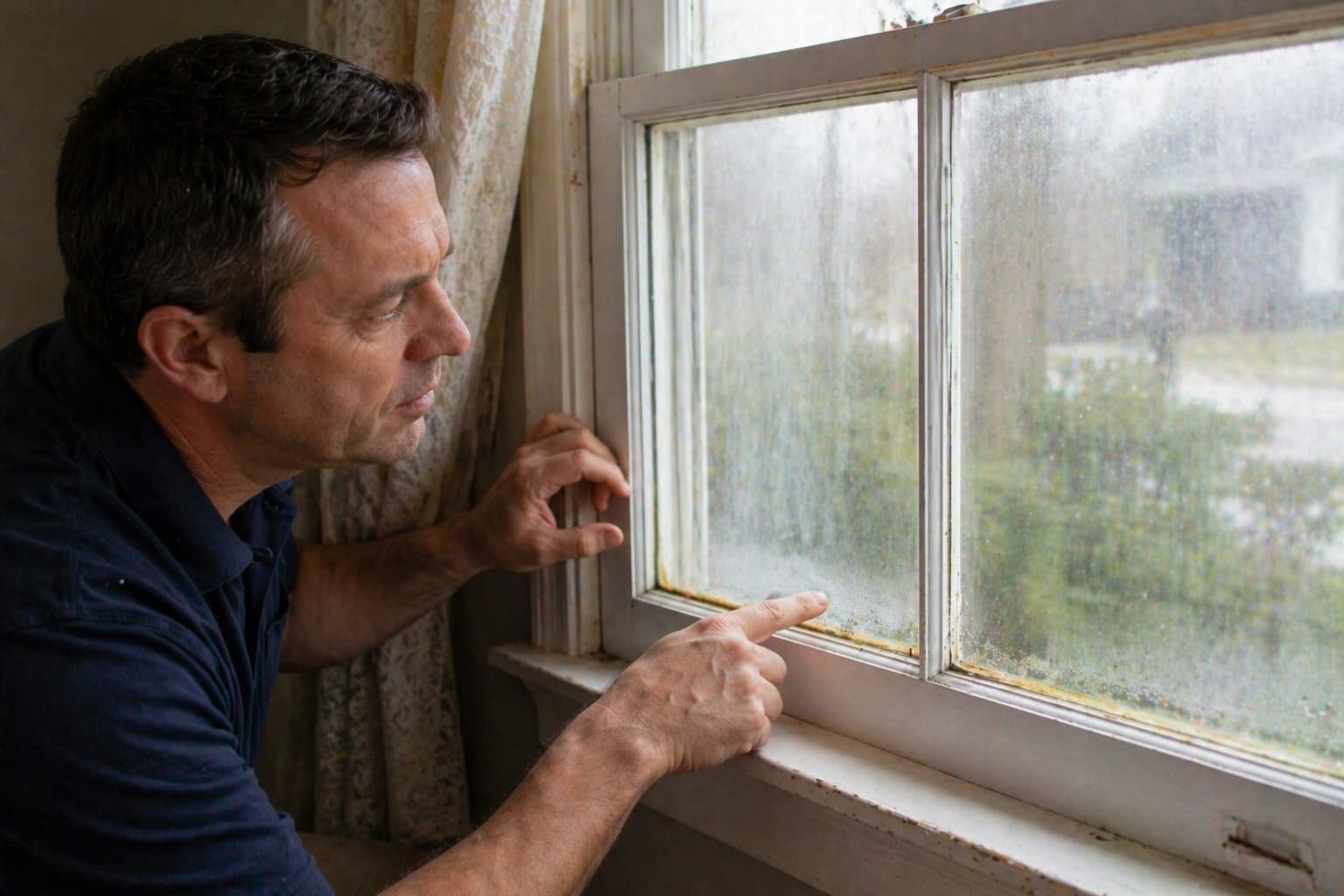
Window replacement is almost certainly overdue when you notice fog, haze, or a milky film between the panes of a double-pane window that cannot be wiped away from either surface. This is the most unambiguous sign of insulated glass unit failure. The seal around the perimeter of the double-pane unit has failed, atmospheric moisture has entered the cavity, and condensed on the inner glass surfaces. The insulating gas — argon or air — has been displaced or contaminated. The window’s thermal performance has degraded significantly, and the fogging will not resolve on its own. In many cases the glass unit can be replaced without removing the entire frame, but the unit as it stands is no longer performing its function.
Draughts Around the Frame
A draught you can feel near a closed window on a cold Lansing day is air infiltration — outside air moving through gaps in the frame, around the weatherstripping, or through a unit that has shifted out of square. Hold your hand near the frame perimeter on a cold day and move it slowly around the edges. A noticeable temperature differential between the frame area and the centre of the room indicates infiltration. Some draught issues are addressable with weatherstripping replacement or resealing. Others indicate a frame that has warped or settled beyond repair, or a unit that was never correctly installed and has allowed moisture behind the cladding. We assess which is which during the free estimate.
Rising Heating Bills Without a Clear Cause
Window replacement delivers measurable heating cost reductions in Lansing homes where the existing glass is underperforming — but the reverse is also true. If your heating bills have risen steadily over several winters without a change in your heating system, usage patterns, or energy prices, degrading window performance is one of the most likely causes. Original single-pane windows and early double-pane units without low-E coatings lose a disproportionate share of a home’s heat through the glass. As those units age further and seals weaken, the loss increases. The connection between window condition and heating cost is direct, and it compounds over Lansing’s six to seven month heating season.
Condensation on the Interior Glass Surface
Interior surface condensation — moisture forming on the room-facing surface of the glass rather than between the panes — is different from seal failure and does not indicate a failed window unit. It indicates that indoor humidity is high enough that the glass surface is reaching dew point temperature. This is common in Lansing homes during winter when heating systems run continuously and indoor air holds more moisture than cold outdoor air. Interior condensation is a ventilation and humidity management issue rather than a window failure. However, if condensation is forming consistently on windows that are relatively new and correctly installed, it may indicate that the windows have a lower U-factor than the room’s conditions require — meaning the glass surface is getting cold enough to condense moisture from normally humidified indoor air.
Windows That Are Difficult to Open, Close, or Lock
A window that sticks, binds, requires significant force to operate, or will not latch correctly is both a convenience problem and a security concern. In Lansing’s older housing stock, stiff or seized windows are most commonly caused by frame warping from moisture exposure, paint buildup in the channel, failed balance mechanisms in double-hung units, or seized hardware in casement and awning windows. Hardware failure is often repairable. Frame warping from prolonged moisture exposure is usually a sign that the unit has reached the end of its serviceable life. A window that cannot be locked correctly is also a safety issue that should not be left unaddressed.
Visible Frame Deterioration
Soft spots, discolouration, crumbling paint, and visible rot in wood frames are signs that moisture has been entering the frame for an extended period. In Lansing’s pre-1960s housing stock — particularly on the Westside and in historic areas like Mason — wood frame deterioration is common and ranges from minor surface rot to structural failure of the sill or jamb. Minor rot can be stabilised with consolidant and filler. Advanced rot that has compromised the structural integrity of the frame requires full frame replacement before a new glass unit can be correctly installed. Leaving deteriorated frames in place and installing new glass units into them is a false economy — the unit will not seal correctly and will fail prematurely.
Your Windows Are More Than 20 Years Old
Window replacement becomes worth evaluating seriously when units are more than 20 years old, regardless of visible condition. The insulating gas in double-pane units degrades over time even without obvious seal failure. Low-E coatings on units manufactured before the mid-2000s were less advanced than current coatings and have degraded further with age. Frame seals and weatherstripping have a finite lifespan. A home in Lansing with original 1990s windows is operating with glass that falls well short of current Energy Star Northern zone standards — and the gap between its performance and a modern replacement unit is wide enough to justify replacement on thermal grounds alone, before any visible failure has occurred.
For independent guidance on window energy performance ratings, visit energystar.gov.